Progressive Myopia: Causes, Risks and How to Slow It Down


Progressive myopia is not a condition that plateaus on its own. For millions of people across the UK, short-sightedness that begins in childhood continues to worsen through the teenage years and, in many cases, into early adulthood, with each passing year bringing a stronger prescription and a higher lifetime risk of serious eye disease.
What drives that progression, who is most at risk, and which treatments can actually slow myopia progression are the questions worth answering if you want to protect your vision long term.
What Is Progressive Myopia?
Myopia, or short-sightedness, occurs when the eyeball grows slightly too long from front to back, which causes light to focus in front of the retina rather than directly on it. The result is clear vision up close and blurred vision at a distance.
Progressive myopia is the term used when the prescription does not stay stable. Instead of settling at a fixed level, it worsens over time, typically measured as an increase in the minus power of the prescription from one year to the next. Clinically, progression is defined as a change of at least 0.50 dioptres per year, though in some children and young adults, it moves considerably faster than that.
This is not a rare pattern. Most myopia that develops in childhood progresses throughout the school years and often continues into the mid-twenties before it stabilises. The earlier myopia appears, the longer the window of progression, and the higher the prescription tends to be by the time the eye finally stops growing.
Why Does Myopia Get Worse?
The primary driver of myopia progression is axial elongation, the continued growth of the eyeball along its front-to-back axis. As the eye grows longer, the point at which light focuses shifts further in front of the retina, and blurred vision at a distance becomes progressively worse with each passing year.
Genetics contribute significantly to how fast this happens. Children with one or both myopic parents develop myopia more frequently and tend to show faster myopic progression, but genetics alone does not account for the full picture.
Environmental factors are just as important, and in many cases, they are what push a predisposed child toward worsening myopia through the school years and into early adulthood.
Extensive near work, whether reading, studying, or prolonged screen time on digital devices, is strongly associated with faster progression. Part of the reason comes down to how standard spectacle lenses handle peripheral vision. They correct the central field and deliver clear distance vision, but leave peripheral light rays focusing behind the retina, which sends a continuous signal to the eye that encourages further growth.
Limited time spent outdoors compounds this further, since natural daylight appears to slow axial elongation, and children who spend more time outside consistently show slower progression rates than those who spend the majority of their day indoors.
Who Is at Risk?

Myopia progression does not affect everyone at the same rate. Some people stabilise at a low prescription in their mid-teens, while others reach high myopia by the time they finish university.
Children with two myopic parents face the highest genetic risk, and those with one myopic parent are still considerably more likely to experience progressive myopia than children with no family history of short-sightedness.
Early myopia onset is one of the strongest predictors of a high final prescription. A child who develops myopia at six or seven has a much longer progression window than one whose myopia appears at twelve, and the difference by early adulthood is often substantial.
Young adults are a group that is frequently overlooked. Adult myopia progression is commonly assumed to have stopped, but for a portion of people, it continues into the late twenties, particularly in those with a history of rapid childhood progression.
People in certain professions and education environments, where sustained near work fills most of the day, consistently show higher rates of myopic progression than those whose daily routine involves more varied visual demands.
The Long-Term Risks of Unmanaged Myopia Progression
The most immediate consequence of worsening myopia is a stronger prescription every year, but the risks that come with unmanaged myopia progression go well beyond the inconvenience of thicker lenses or frequent visits to the eye doctor.
High myopia, generally defined as a prescription beyond minus six dioptres, is directly associated with a range of serious eye diseases that carry a genuine risk of permanent vision loss in later life. The higher the prescription, the greater the likelihood of these complications developing, and the earlier in life they tend to appear.
Retinal detachment is one of the most serious risks. As the eye grows longer, the retina is stretched thinner across a larger surface, and that thinning increases the likelihood of tears and detachment. Retinal detachment is a medical emergency that requires immediate treatment and can result in permanent vision loss if it is not caught quickly.
Myopic maculopathy develops when the elongated eye causes damage to the macula, the central part of the retina responsible for sharp, detailed vision. It is one of the leading causes of irreversible visual impairment in people with severe myopia and becomes significantly more common as the prescription increases beyond minus six dioptres.
Glaucoma occurs at higher rates in myopic eyes, with pathological myopia carrying a substantially elevated risk compared to the general population.
Cataracts also develop earlier in people with high myopia, often appearing decades sooner than they would in someone with normal vision.
These are not remote possibilities. They are documented outcomes of unmanaged myopia progression, and the evidence consistently shows that slowing progression during childhood and early adulthood reduces the lifetime risk of each one of them significantly.
Can You Slow Myopia Progression?
The short answer is yes, and the evidence behind myopia control has grown substantially over the past two decades. Several treatments now have strong clinical backing for their ability to reduce the rate at which myopia progresses, and myopia management has moved from a niche area of optometry into mainstream clinical practice.
What these treatments do not do is reverse myopia that has already developed or restore vision to what it was before progression began. The goal of myopia control is to slow the rate of axial elongation during the years when the eye is most actively growing, so that the prescription at stabilisation is as low as possible and the associated risks of high myopia are reduced accordingly.
The earlier the intervention begins, the greater the potential benefit. A child whose myopia is managed from the age of eight has significantly more to gain than one whose treatment begins at fourteen, simply because there are more years of progression left to influence. That said, myopia management is not exclusive to children.
Young adults whose prescription is still changing year on year can also benefit from treatments that slow progression, and an eye test with an experienced optometrist is the right starting point for anyone whose vision correction needs keep increasing.
Treatment Options for Progressive Myopia
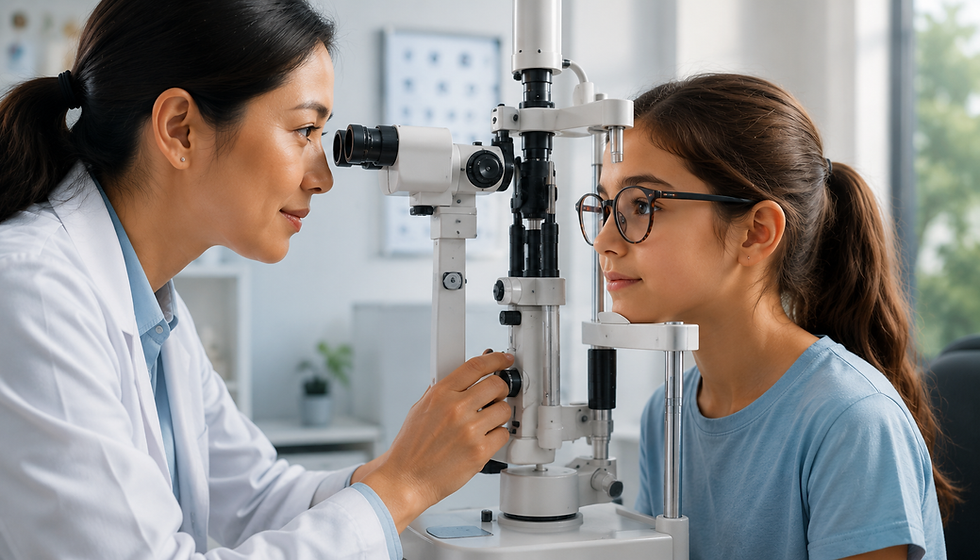
Several treatments now have strong clinical evidence behind them for slowing myopia progression, and the right option depends on the individual's age, prescription, and lifestyle. At Aristone Optical, we assess each patient individually and recommend the approach most suited to their specific situation.
Myopia Control Glasses
Myopia control glasses look identical to ordinary glasses from the outside, but the lens technology works fundamentally differently from standard single vision spectacle lenses. Rather than correcting only the central field of vision, they address peripheral light rays simultaneously, shifting peripheral focus forward to reduce the stimulus for further axial elongation.
Essilor Stellest lenses have shown an average 67% reduction in myopia progression compared to standard lenses when worn for at least twelve hours a day, while Zeiss MyoCare operates on a similar principle with a strong and growing body of clinical evidence behind it.
Multifocal Contact Lenses
For older children or those who prefer not to wear glasses full time, soft contact lenses designed for myopia control offer an equally effective alternative.
CooperVision MiSight 1 day lenses are daily disposable lenses approved specifically for myopia control, with six years of clinical data showing an average 59% reduction in progression compared to standard single vision contact lenses.
Orthokeratology (Corneal Refractive Therapy)
Corneal refractive therapy, or Ortho-K, involves rigid lenses worn overnight that reshape the cornea during sleep, delivering clear distance vision throughout the day without glasses or daytime contact lenses.
Beyond the convenience, Ortho-K has a well-documented myopia control effect and is particularly suited to children and young adults involved in sports or activities where wearing glasses is impractical.
Low Dose Atropine Eye Drops
Low dose atropine eye drops, typically used at concentrations of 0.01% or 0.05%, slow the mechanisms that drive eye growth and are applied once daily. At these concentrations, side effects are minimal, and the drops can be used alongside glasses or contact lenses.
This option is most commonly considered for patients with faster progressing myopia or where other treatments have not produced sufficient results.
When to See an Optician?
Anyone whose prescription has changed at two or more consecutive eye tests, or whose blurred vision at a distance seems to be worsening between appointments, should not wait until their next scheduled visit. Worsening myopia that goes unmonitored is myopia that goes unmanaged, and the window in which treatment produces the greatest benefit does not stay open indefinitely.
Children should have regular eye tests throughout primary and secondary school, regardless of whether myopia has been diagnosed, since myopia onset often goes unnoticed until a routine test confirms it. Adults whose prescription has been stable for years but begins shifting again should treat that change as a signal worth investigating rather than an inconvenience to be updated at the next available appointment.
An eye test is the only way to know whether progression is happening, how fast it is moving, and whether the current approach to vision correction is adequate.
Book a Myopia Management at Aristone Optical
If your prescription keeps changing year on year, or your child has recently been diagnosed with myopia and you want to understand what can be done to slow its progression, we are here to help.
At Aristone Optical in Fulham, we have been caring for London families for 70 years, and our myopia management service is built around the individual needs of each patient, whether that is a seven-year-old whose myopia has just been identified or a young adult whose vision correction needs keep increasing.
A consultation with our optometrist covers a full assessment of your eye health, a detailed discussion of the treatment options available, and a clear recommendation based on your age, prescription, and lifestyle.
To book an appointment, call us on 020 7385 9772 or use the contact form on our website.


Comments