MiSight vs Ortho-K: Choosing the Right Myopia Management Option for Your Child

Every year, millions of parents sit in an optometrist's chair and hear the same thing: the prescription has gone up again. For children with myopia, that pattern rarely stops on its own. The eye keeps growing, the prescription keeps climbing, and the long-term risks grow with it.
MiSight contact lenses and ortho-k lenses both interrupt that pattern. They slow eye growth, reduce myopia progression, and give children clearer vision while doing it. But they are very different treatments, and the one that works best depends entirely on the child.
We will walk you through how each option works, where they differ, and what to think about before making the decision.
What Is Myopia and Why Does It Need Managing?
Myopia typically develops in school-aged children and progresses through the teenage years as the eye continues to grow. The eye grows too long, which means light entering it focuses in front of the retina rather than on it, and the result is blurry vision at a distance. Glasses and standard contact lenses correct that blurry vision, but they do nothing to slow the eye growth that drives the prescription higher each year.
A child who reaches adulthood with a prescription of -1.00 or -2.00 faces a very different level of risk than one who reaches around -6.00 or worse, often considered high myopia. High myopia significantly raises the lifetime risk of retinal detachment, macular degeneration, glaucoma and cataract. These are not rare outcomes at high prescriptions.
They are well-documented consequences of unchecked eye growth during childhood.
Early intervention with a clinically proven myopia control treatment changes that trajectory. The goal is not just a clearer vision today. It is a lower prescription, better eye health and a meaningfully reduced risk of serious complications in adulthood.
How MiSight Contact Lenses Work?
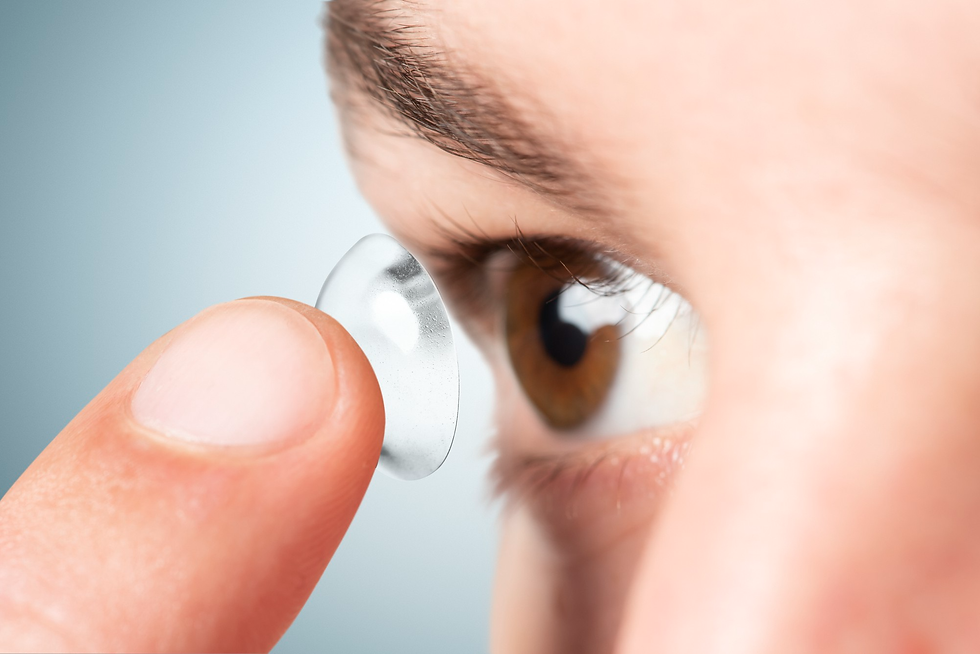
MiSight 1 day are soft daily disposable contact lenses worn during the day. Each lens has two vision correction zones and two treatment zones, arranged in alternating rings. The correction zones address your child's prescription and deliver the same clear distance vision as any standard daily contact lens. The treatment zones work differently. They focus peripheral light in front of the retina, which sends a signal to the eye to slow its elongation.
The result is a lens that corrects myopia and treats it at the same time. In a six-year multicenter clinical trial, children wearing MiSight 1 day experienced 59% slower myopia progression compared to those in standard single vision contact lenses, with nearly all children responding to treatment. MiSight is the first and only FDA-approved soft contact lens proven to slow myopia progression in children, and one of the most extensively studied myopia control contact lenses available.
At the end of each day, the lens is discarded. There is no cleaning routine, no storage solution and no maintenance. A fresh lens goes in the next morning.
How Ortho-K Lenses Work?
Orthokeratology lenses take a fundamentally different approach. Ortho-k lenses are rigid gas permeable lenses worn overnight while the child sleeps. As the lenses are worn, they gently reshape the cornea temporarily, correcting the refractive error so that when the child wakes up and removes the lenses, they can see clearly throughout the day without daytime contact lenses or glasses.
The cornea gradually returns to its original shape during waking hours, which is why the lenses must be worn every night for the effect to be maintained. Beyond vision correction, the reshaping of the cornea also alters how peripheral light focuses on the retina, which produces a myopia control effect similar in principle to MiSight. Clinical studies show ortho-k reduces myopia progression by approximately 50% compared to standard corrective lenses.
Ortho-k lenses can address a wider prescription range than MiSight, including moderate to higher levels of myopia up to around -6.00 dioptres in most cases, though some custom designs can address higher prescriptions.
MiSight vs Ortho-K: How They Compare
Both treatments slow myopia progression effectively, but they differ significantly in how they are worn, what they can correct and what they ask of the child and family.
MiSight 1 Day | Ortho-K | |
Lens type | Soft daily disposable | Rigid gas permeable |
When worn | During the day | Overnight |
Vision during the day | Corrected by the lens | Clear without any lenses |
Prescription range | -0.75 to -4.00, up to -0.75 astigmatism | Up to around -6.00 in most cases, mild astigmatism |
Lens care | None, discarded daily | Nightly cleaning and disinfection |
Fitting process | Straightforward | Custom fitted, more follow-up |
Initial cost | Lower | Higher |
FDA approved for myopia control | Yes | No |
Myopia control efficacy | ~59% over three years | ~50% |
Best for | Younger children, daytime wearers | Active children, higher prescriptions |
Which Children Do Better with MiSight?
MiSight is a stronger option for younger children who are comfortable wearing contact lenses during the day. The soft lens material means adaptation is quick, and a lost or damaged lens is simply replaced from the monthly supply.
Children with prescriptions between -0.75 and -4.00 dioptres with no more than 0.75 dioptres of astigmatism fall within the MiSight fitting range. For families who want a myopia control treatment that fits naturally into a normal school day without any lifestyle adjustment, MiSight is usually the more straightforward choice.
It is also a stronger option for children who are not yet ready for the discipline that nightly ortho-k lens care demands. The daily disposable format removes that responsibility entirely, and the daytime wearing schedule means parents can supervise insertion and removal as part of the morning routine.
Which Children Do Better with Ortho-K?
Ortho-k is a stronger option for children who dislike wearing lenses during the day, or whose lifestyle makes daytime contact lens wear impractical. Because the lenses are worn overnight and removed in the morning, the child goes through the entire school day, sports session or swimming lesson without any corrective lenses at all. For active children, that freedom is a significant advantage.
Children with higher prescriptions also tend to gravitate toward ortho-k. For a child whose prescription has already moved past -4.00, ortho-k is often the only contact lens-based myopia control option available.
The trade-off is the daily commitment. The lenses require nightly cleaning and disinfection, the fitting process involves more follow-up appointments, and the initial cost is higher than MiSight. Families who choose ortho-k need to be committed to the routine, as the myopia control effect depends entirely on the lenses being worn consistently every night.
Book a Myopia Consultation at Aristone Optical
If your child's prescription is changing year on year, the right time to act is now. At Aristone Optical in Fulham, we offer both MiSight 1 day lenses and ortho-k as part of our myopia management programme, and our optometrist will go through every option with you before any decision is made.
To book a myopia consultation, call us on 020 7385 9772 or get in touch using the form below.


Comments