Myopia Control for Children: Signs, Risks and What Parents Can Do

Short-sightedness in children is no longer a minor inconvenience that a pair of glasses fixes and solves. It is a progressive eye condition that, without proper management, tends to worsen throughout childhood and into the teenage years, and in some cases carries serious risks into adult life.
This article explains what myopia is, how to spot it in your child, why early detection changes outcomes, and which myopia control treatment options are now available to slow progression.
What Is Childhood Myopia?
Myopia, or short-sightedness, is a very common eye condition in which distant objects appear blurred while close-up objects remain clear. It occurs when the eye grows slightly too long from front to back, which causes light to focus in front of the retina rather than directly on it. The result is that a child can read a book without difficulty but struggles to see the board at school or read a sign across the street.
Childhood myopia typically develops between the ages of six and thirteen, and in many children, it worsens progressively until the late teenage years or early twenties. The condition tends to run in families, so children with one or both parents who are short-sighted face a statistically higher risk of developing it themselves.
Alongside genetics, increased screen time and reduced outdoor time are strongly associated with rising rates of myopia in children across the UK and internationally.
Signs of Myopia in Children: What to Look For
Children do not always report vision problems clearly because they may assume that blurred distance vision is normal. Parents and teachers are often the first to notice something is not right.
Squinting at distant objects is one of the most recognisable indicators. When a child squints at the television, a whiteboard, or anything at a distance, they are instinctively trying to narrow their field of vision to improve clarity. It works briefly but signals that their eyes are not focusing correctly without effort.
Sitting close to screens or holding books at an unusually short distance can point to short-sightedness. While near vision is typically clear in myopic children, the habit of getting very close to a screen often indicates that the child is compensating for difficulty elsewhere.
Frequent headaches and eye fatigue, particularly after school, may result from the sustained effort of trying to focus on distant objects. The eyes work harder than they should throughout a school day, and tiredness or headaches by the afternoon can follow.
Reduced engagement with outdoor activities sometimes follows the onset of myopia. A child who previously enjoyed sport but begins to seem less interested may be finding it harder to track moving objects or see clearly at a distance.
Complaints about the whiteboard at school are a direct signal. Many cases of childhood myopia are first noticed by teachers who observe a child struggling to copy from the board or simply not engaging with what is written there.
If any of these signs are present, an eye test is the right first step. NHS eye tests are free for children under 16, which removes the financial barrier to early detection entirely.

Why Early Detection and Myopia Control Matter
A child receiving glasses for the first time is not the end of the story. Standard glasses and contact lenses correct blurred vision but do not address the underlying progression of myopia. Without myopia control, the prescription typically worsens year on year as the eye continues to grow.
This matters for two reasons. The first is practical. A child whose myopia progresses rapidly will need stronger glasses every year, and by the time they reach adulthood, their prescription may be significantly higher than it would have been with effective intervention.
The second reason is clinical. High myopia, defined as a prescription of minus six dioptres or beyond, is associated with a range of serious eye health complications in later life. These include retinal detachment, in which the retina pulls away from the back of the eye and threatens permanent vision loss, as well as glaucoma, myopic maculopathy, and an increased risk of cataracts developing earlier than average. These are documented outcomes of high-degree myopia that clinical research has consistently linked to unmanaged progression in childhood.
The goal of myopia control is not to cure short-sightedness. It is to slow the rate at which a child's myopia increases, so that by the time they reach adulthood, the prescription is as low as possible and the associated future eye health risks are reduced. Research suggests that slowing progression by even one or two dioptres during childhood can meaningfully reduce the likelihood of complications decades later, which is why early intervention produces long-term benefits that go well beyond providing clear vision in the short term.
Outdoor time has a well-documented protective effect against the onset and progression of myopia. Children who spend more time outside, particularly in natural daylight, develop myopia less frequently and at a later age. Current guidance generally recommends at least ninety minutes of outdoor time per day for school-age children, and encouraging regular breaks from close work supports eye comfort alongside any clinical treatment in place.
Myopia Control Treatment Options
Several treatments now have strong clinical evidence behind them for slowing myopia progression in children. Myopia management is not a one-size-fits-all process, and at Aristone Optical, we match each child to the approach most suited to their age, lifestyle, and prescription.
Myopia Control Glasses
Myopia control glasses are the most accessible starting point for younger children or those whose parents prefer a spectacle-based option. These are not standard glasses. They use advanced lens technology to correct distance vision in the central zone, while the peripheral areas of the lens are designed to reduce the stimulus that drives eye growth.
Essilor Stellest lenses are one of the most clinically studied options in this category. Stellest lenses use a technology called H.A.L.T., which stands for Highly Aspherical Lenslet Target, and clinical trials have demonstrated that they slow myopia progression by an average of 67% compared to standard single-vision lenses when worn for at least twelve hours a day.
They look and feel like ordinary glasses, which makes them well suited to children who are not yet ready for contact lenses.
Zeiss MyoCare lenses operate on a similar principle, using what Zeiss calls C.A.R.E. technology to produce a myopia control effect across the lens surface. Zeiss MyoCare is a well-researched option with a growing body of clinical evidence supporting its effectiveness.
Contact Lenses for Myopia Control
For older children or those who prefer not to wear glasses full time, contact lenses offer an effective alternative route to myopia control.
CooperVision MiSight 1 day lenses are daily disposable contact lenses specifically licensed for myopia control in children. They use a dual-focus design that corrects distance vision while simultaneously sending a signal to the eye that discourages further growth. Clinical trials over a six-year period showed that MiSight lenses slowed myopia progression by an average of 59% compared to standard single-vision contact lenses. They are approved from age eight upwards, and many children adapt to them quickly.
Orthokeratology, commonly called Ortho-K, involves rigid lenses worn overnight that gently reshape the cornea during sleep. When removed in the morning, the child can see clearly throughout the day without needing glasses or daytime lenses. Beyond the convenience, Ortho-K has a well-documented myopia control effect and is particularly useful for children involved in sports or activities where glasses are impractical.
Low Dose Atropine Eye Drops
Low dose atropine is a pharmacological approach to myopia control that has been used in clinical practice across Asia for many years and is gaining traction in the UK. Atropine eye drops at very low concentrations, typically 0.01% or 0.05%, are applied once daily and work by relaxing the mechanisms that drive eye growth.
At these low doses, side effects are minimal compared to the higher concentrations used historically, and the drops can be used alongside glasses or contact lenses. This option is typically considered for children with faster-progressing myopia or where other treatments have not produced sufficient results.
Ongoing Monitoring and Follow-Up
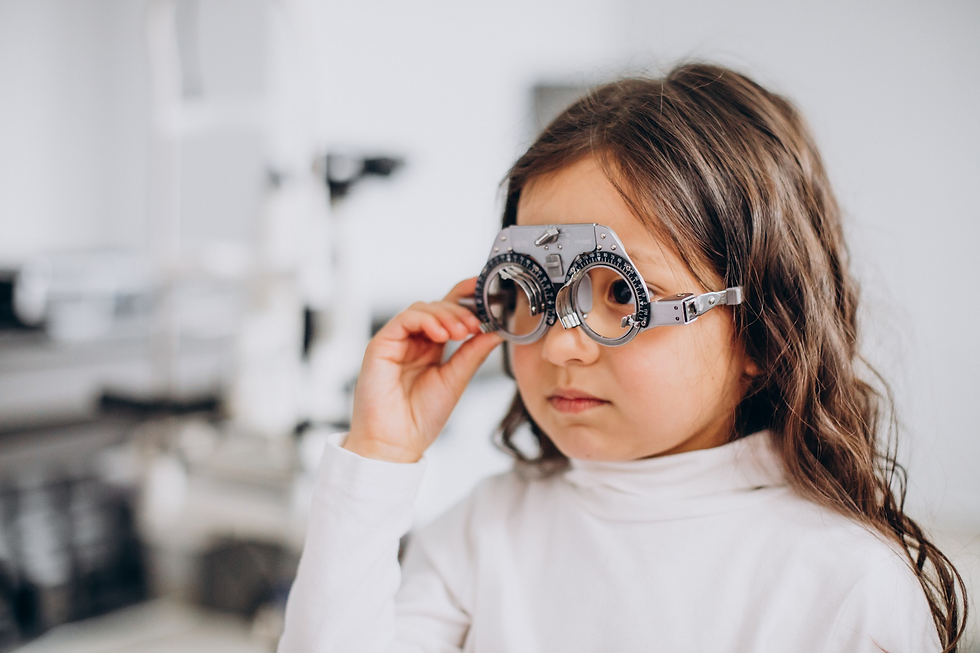
Regular check-ups are a core part of any myopia control plan. At Aristone Optical, we review each child's prescription at set intervals to see whether the chosen treatment is holding progression in check, and we change course if it is not.
The ages of eight to fourteen are the years when short-sightedness tends to move fastest, so staying on top of changes during that window makes a real difference to where a child's prescription ends up by adulthood.
Parents also often ask about laser eye surgery as a potential solution. It is worth noting that laser surgery is only available to adults once the prescription has been stable for a minimum of two years, and is not suitable for children or teenagers whose myopia is still progressing.
The earlier myopia control begins in childhood, the lower the prescription is likely to be by the time a young adult reaches the age at which surgery might become an option.
Book a Myopia Consultation at Aristone Optical
If your child is showing signs of short-sightedness, or if you already know they are myopic and want to understand whether their progression is being managed effectively, we are here to help.
At Aristone Optical in Fulham, we have been caring for London families for 70 years, and our myopia management service is built around the individual needs of each child.
A consultation with our optometrist covers a full assessment of your child's eye health, a detailed discussion of the available treatment options, and a clear recommendation based on their age, prescription, and lifestyle.
To book an appointment, call us on 020 7385 9772 or use the contact form on our website.


Comments